

When people hear that Giant Swarm is building an AI Operating System, the first reaction is usually: “Wait, aren’t you the Kubernetes company?”
Fair question. Let me explain why this isn’t the pivot it might look like.
For over a decade, we’ve been doing one thing well: running production infrastructure for enterprises that can’t afford it to break. Kubernetes management, platform engineering, operational reliability — the unsexy but critical work that sits between “the developer pushed code” and “the service is running in production at 3am.”
What we’ve learned from that work is that the hardest problem in enterprise technology isn’t building something clever. It’s making something clever run reliably, under governance, at scale, in environments where failure has consequences.
That problem hasn’t changed. The workloads have.
AI workloads are the new thing that enterprises need to run seriously. Not as demos, not as experiments — as production systems that touch real data, make real decisions, and need real oversight.
And the gap we see is familiar: most AI tooling is built by companies working their way down toward infrastructure. They start with models, add some orchestration, and eventually realise they need to figure out deployment, security, compliance, and operations. That “figuring it out” phase is where enterprises get hurt.
We’re coming from the other direction. We already know how to run things in production. We already have the trust of enterprises that need this done right. What we’re adding is the AI-specific layer — the governed access (Muster), the agent runtime (Klaus), and the evolution path from AI to automated workflows.
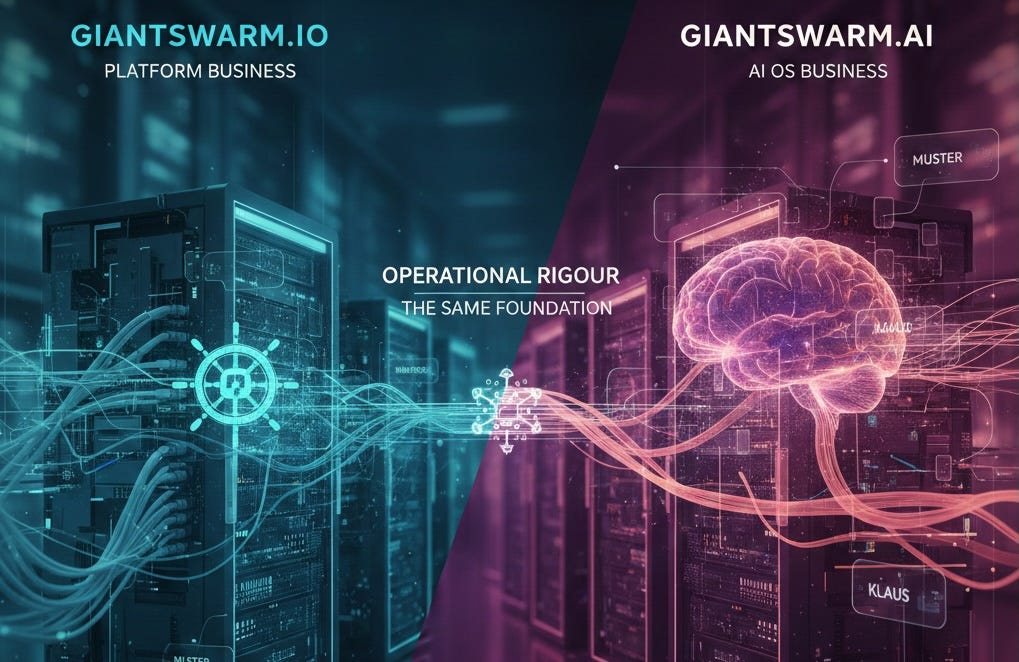
This is why we now have two complementary businesses:
giantswarm.io — our platform business. The Kubernetes management platform that enterprises and cloud providers rely on. Battle-tested. Production-grade. This isn’t going anywhere.
giantswarm.ai — our AI OS business. Muster, Klaus, and what comes next. Built on the same operational rigour as the platform, but designed for the age of AI workloads.
The foundation is the same. The operational expertise is the same. The customer relationships are the same. What’s new is the workload type — and the recognition that enterprises need someone they trust to run AI the way we’ve always run infrastructure: seriously.
I won’t pretend this isn’t ambitious. Building an AI Operating System on top of a platform business requires focus and execution. But the alternative — watching AI tooling vendors struggle to learn what “production-ready” means while our customers wait — didn’t feel like the right choice.
We know what keeps a CTO up at night. We know what “it works reliably at 3am” actually requires. And we know that the gap between a demo and production is exactly the gap we’ve always filled.
The job hasn’t changed. The workloads have.
If you’re wondering what a serious enterprise AI runtime looks like — one built by people who’ve been operating production infrastructure for years — I’d enjoy that conversation.